
Executive Summary
New Zealand procures two classes of instantaneous reserve in every trading period — fast (FIR, response within 6 seconds) and sustained (SIR, within 60 seconds) — to cover the sudden loss of the largest generator or the HVDC link. For decades that cover came from partially-loaded hydro and thermal plant and interruptible load, priced by the opportunity cost of holding capacity back from the energy market.
Grid-scale batteries changed the economics overnight. A battery can offer its full capacity as reserve while sitting idle, at close to zero opportunity cost. New Zealand's first two large batteries — Meridian's Ruakākā BESS (100 MW / 200 MWh, in service mid-2025) and Contact's Glenbrook BESS (100 MW, March 2026) — are together barely 1% of national capacity, yet they have been enough to collapse reserve prices to a fraction of their historical level.
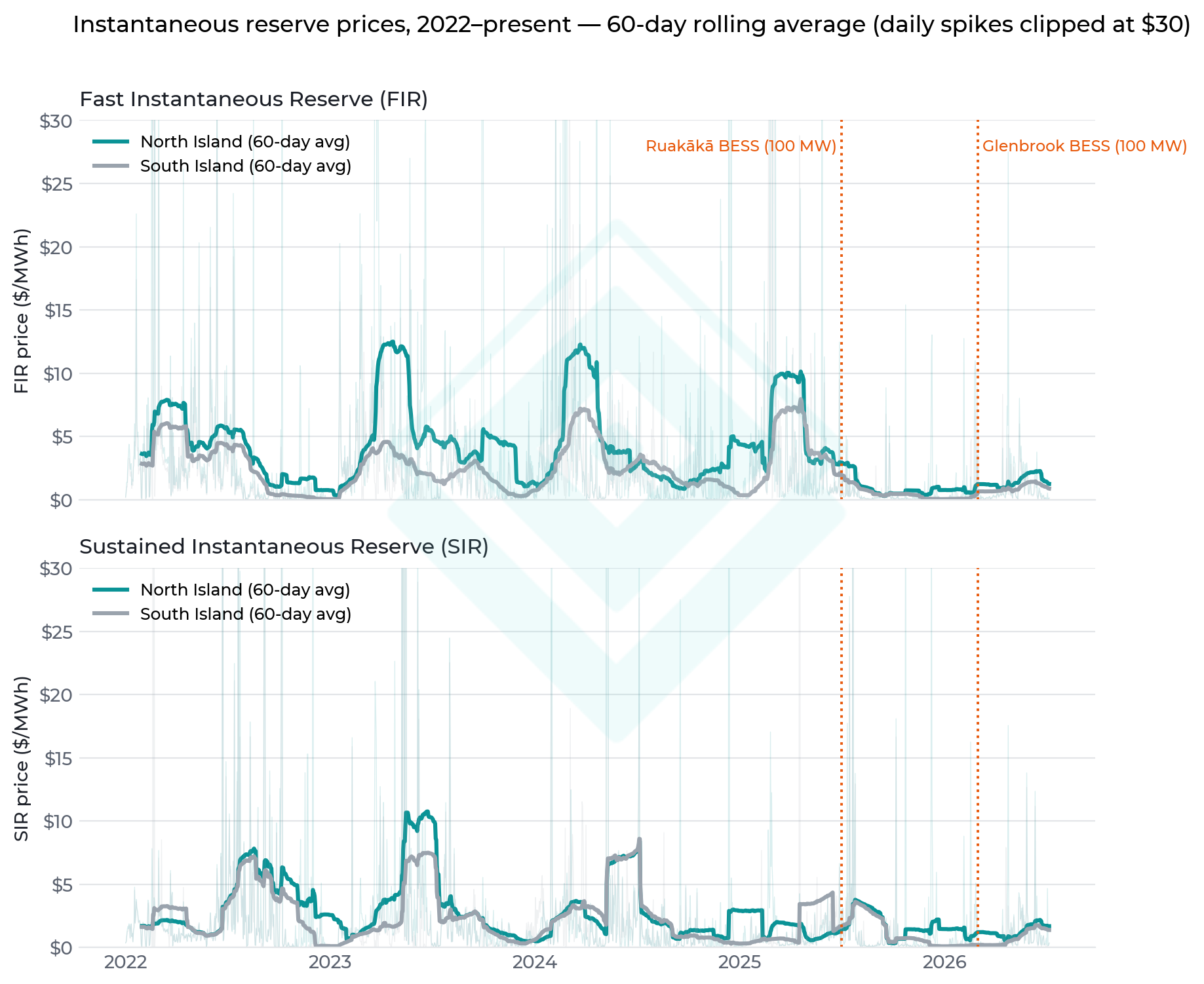
- North Island FIR averaged $4.30/MWh over 2022–2024 and $5.16/MWh in the tight first half of 2025 — then fell to $0.82/MWh in the eight months after Ruakākā entered service, an ~80% collapse that has held through winter 2026 ($1.22/MWh since March).
- SIR followed the same path: North Island averages fell from $3.22/MWh (2022–2024) to $1.75–$1.23/MWh after the batteries arrived.
- The collapse is national, not just local: South Island FIR fell from $2.43 to $0.37/MWh over the same boundary, because reserve requirements and risk-setting are coupled across the HVDC link even though the islands clear separately.
- The seasonal signature vanished: every autumn–winter from 2022 to 2025 produced a FIR ramp to $10–12/MWh on the 60-day average; winter 2026 — the first with both batteries in service — shows no ramp at all.
- Timing rules out coincidence: the collapse arrived in the middle of 2025's tight, high-priced energy market — conditions that in any prior year would have driven reserve prices up, not down.
- North Island reserve procurement cost fell from ~$17M (2023) and ~$14M (2024) to ~$9M in 2025 — savings that flow to load — while future battery investors can no longer bank on reserve revenues: with ~7,000 MW of BESS in the connection pipeline, the ancillary-services layer of the battery revenue stack has largely been arbitraged away by the first two movers.
The Price Record
The rolling averages tell the story cleanly. FIR and SIR prices cycled with system tightness for years, peaking each autumn and winter. Ruakākā's entry in mid-2025 flattens both series; Glenbrook's arrival in March 2026 lands on a market already saturated, and prices barely respond. What remains is a low, spike-punctuated floor: reserves still price up in individual half-hours when the batteries are unavailable or energy prices make discharging more attractive, but the sustained scarcity premium is gone.
The discontinuity is stark on either side of the commissioning line. The first half of 2025 — dry, tight, with high winter energy prices — ran at the elevated FIR levels typical of every tight first half in the record ($5.16/MWh in the North Island; the first halves of 2022–2024 averaged $5.65–6.99/MWh). The eight months that followed, under near-identical energy-market stress, were the cheapest ($0.82/MWh). The only structural change between those windows was 100 MW of battery capacity entering the reserves market. Prices tick up slightly in the post-Glenbrook window ($1.22/MWh) — winter seasonality still exists, just an order of magnitude smaller than it used to be.
What It Means
For the system, this is unambiguously good: reserve cover is now deeper (batteries respond in milliseconds, faster than the 6-second FIR standard requires) and materially cheaper, with North Island procurement costs roughly halving. For battery economics, it is a cautionary tale in market depth. The NZ reserves market needed only ~200 MW of batteries to saturate; the ~7,000 MW of BESS projects in the Transpower connection pipeline will have to earn their returns almost entirely from energy arbitrage and network services, not ancillary services. Investors extrapolating Ruakākā's early reserve revenues into their models are pricing a market that no longer exists.
Methodology
- Reserve prices: WITS instantaneous reserve prices per island and reserve class (FIR/SIR), 2022 to present; daily averages of half-hourly prices, 60-day rolling means for trend display.
- Price series mixes settlement schedules: FINAL (backfill) to February 2026, live RTD/PRS thereafter — the March 2026 boundary coincides with Glenbrook's commissioning and is treated with caution in attribution (the main collapse predates it).
- Era averages: simple means of daily average prices within each window (pre-battery 2022–2024; Ruakākā ramp H1 2025; post-Ruakākā Jul 2025–Feb 2026; post-Glenbrook Mar 2026–present).
- Procurement cost: price × procured reserve MW × 0.5h summed per year (reserve volumes available from 2022); 2026 excluded from cost comparison due to the schedule boundary.
- Battery dates: Ruakākā BESS (Meridian, 100 MW / 200 MWh) in service ~July 2025; Glenbrook Ohurua BESS (Contact, 100 MW) March 2026. BESS pipeline from Transpower connection data.
Caveats
- Reserve prices also respond to hydro conditions, thermal availability and risk-setter changes; the attribution here rests on timing (collapse mid-2025 against a tight energy market) rather than a structural dispatch model.
- The Ruakākā marker is the approximate full-service date; the battery participated in reserves during commissioning, which likely explains softening in autumn 2025.
- Post-March-2026 prices come from the live dispatch feed rather than final settlement; final settled prices can differ modestly.