
Executive Summary
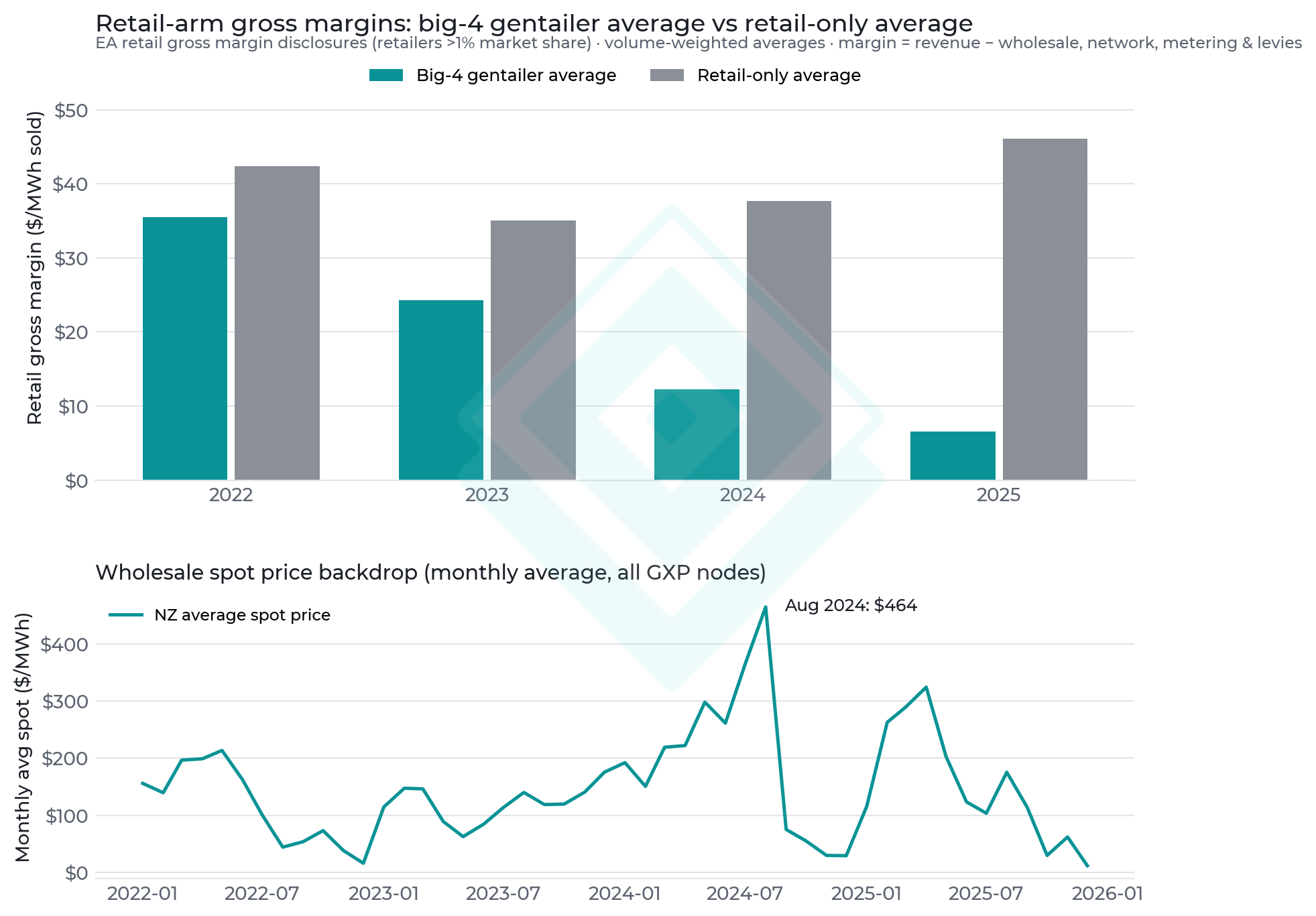
New Zealand's four large gentailers — Contact, Genesis, Mercury and Meridian — generate roughly 95% of the country's electricity and retail most of it. Since 2022 the Electricity Authority has required retailers with more than 1% market share to disclose their retail-arm gross margins, making it possible to watch what happens to the retail business when wholesale prices spike, as they did in mid-2024 (the monthly average spot price peaked at $464/MWh in August 2024) and again in autumn 2025.
The pattern is stark: the big four's retail margins compressed steadily as spot prices rose, two of them to outright negative gross margins by 2025 — while the average margin of retail-only competitors held firm and even rose. Vertical integration is what makes this sustainable: the same high wholesale prices that squeeze the retail arm are earned by the generation arm.
- Big-4 average retail gross margin fell from ~$36/MWh (2022) to ~$6/MWh (2025) as the annual average spot price rose from $116/MWh to $197/MWh (2024) and $151/MWh (2025).
- By 2025, Contact (-3 $/MWh) and Meridian (-3 $/MWh) reported negative retail gross margins — their retail arms sold electricity for less than its wholesale, network and metering cost. Genesis ($9) and Mercury ($20) stayed positive but well below 2022 levels.
- Retail-only competitors' volume-weighted average margin held between $35 and $46/MWh across the same period — rising to its highest level ($46/MWh) in 2025, when the big four's margins were weakest.
- The big four's reported wholesale electricity cost rose from ~$105/MWh (2022) to ~$157/MWh (2025), faster than retail-only players' (~$102 to ~$140/MWh) — consistent with internal transfer prices tracking spot more closely than the hedge books of independents.
- Gross margin is not profit: after operating costs (typically $20–40/MWh to serve), a sub-$10 gross margin implies a loss-making retail business — sustainable only inside a vertically integrated group whose generation arm captures the same high prices.
Margins Through the Price Cycle
The upper panel of Figure 1 shows the volume-weighted average retail gross margin per MWh sold for the big four, alongside the equivalent average for retail-only players; the lower panel shows the monthly wholesale price backdrop, including the August 2024 spike and the autumn 2025 hydro-tightness period.
2022 margins were healthy across the board. As sustained high prices arrived (2024, 2025), the big-4 average converged toward zero — within the group, Contact and Meridian went negative while Mercury retained ~$20–25/MWh — while retail-only players, whose customer prices must recover their full wholesale cost to stay in business, maintained margins in the $35–46/MWh band.
Why This Matters
Two readings are consistent with the data. The benign one: gentailers used their generation profits to shield retail customers from the full wholesale shock, absorbing the squeeze in their retail books. The competition concern (raised by the 2025 Frontier Economics market review): retail prices that sit persistently below wholesale-plus-cost make independent retail entry unattractive precisely when competition is most needed, because only vertically integrated players can sustain them. Both can be true at once — and either way, the disclosed numbers show the retail arms of the big four are not where their profits live in high-price years.
A caveat cuts across all of it: a gentailer's retail-arm wholesale 'cost' is an internal transfer price (ITP) — described by the gentailers themselves, in their Electricity Authority disclosures, as a notional accounting tool — so retail-arm margins partly reflect each group's own transfer-pricing methodology rather than an arm's-length cost. Those methodologies are typically backward-looking averages of ASX futures prices, so as the 2021–2024 price surges rolled into the averages, ITPs rose and the squeeze surfaced mechanically in the retail books rather than in generation (NZIER for the Consumer Advocacy Council, 2024; EA ITP disclosures).
Methodology
- Retail gross margins: Electricity Authority annual retail gross margin disclosures, retailers above 1% market share, 2022–2025. Margin = retail revenue less wholesale electricity, distribution, metering and levy costs, per MWh sold. Independent retailers are anonymised in the source data; their average is volume-weighted where sales volumes are disclosed.
- Big four = Contact Energy, Genesis Energy, Mercury NZ, Meridian Energy, aggregated to a volume-weighted average in Figure 1; individual 2025 figures are cited in the text. Manawa Energy (generation-focused) is excluded from both groups.
- Spot prices: 30-minute wholesale spot prices across all GXP offtake nodes (generation injection nodes excluded), 2022–2025; the backdrop series is the simple average over all node-half-hours, aggregated monthly (annual figures are means of the monthly averages).
- Externally cross-checked: the 2022 disclosure range published by the Electricity Authority ($19.50–$56.57/MWh) matches this dataset's 2022 endpoints (Contact $19.50, Genesis $56.57).
Caveats
- Gross margin excludes retail operating costs (billing, service, acquisition), so it overstates profitability for all players; EA analysis puts cost-to-serve typically at $20–40/MWh.
- Gentailer wholesale costs are internal transfer prices, not arm's-length purchases; retail-arm margins are sensitive to how the group allocates value between generation and retail. Sources: NZIER, 'Gentailer retail margin disclosure — what does it tell us?' (for the Consumer Advocacy Council, June 2024); Electricity Authority ITP and retail gross margin disclosures (ea.govt.nz).
- Disclosure years are EA reporting years; the mid-2024 price spike falls within the 2024 disclosure and the autumn 2025 tightness within 2025.
- Retail-only figures aggregate five anonymised retailers with different customer mixes (residential vs commercial), which affects comparability of $/MWh margins.